Analysis
NEC4 programme checks
What each clause 31 and 32 item checks, and what it can't.
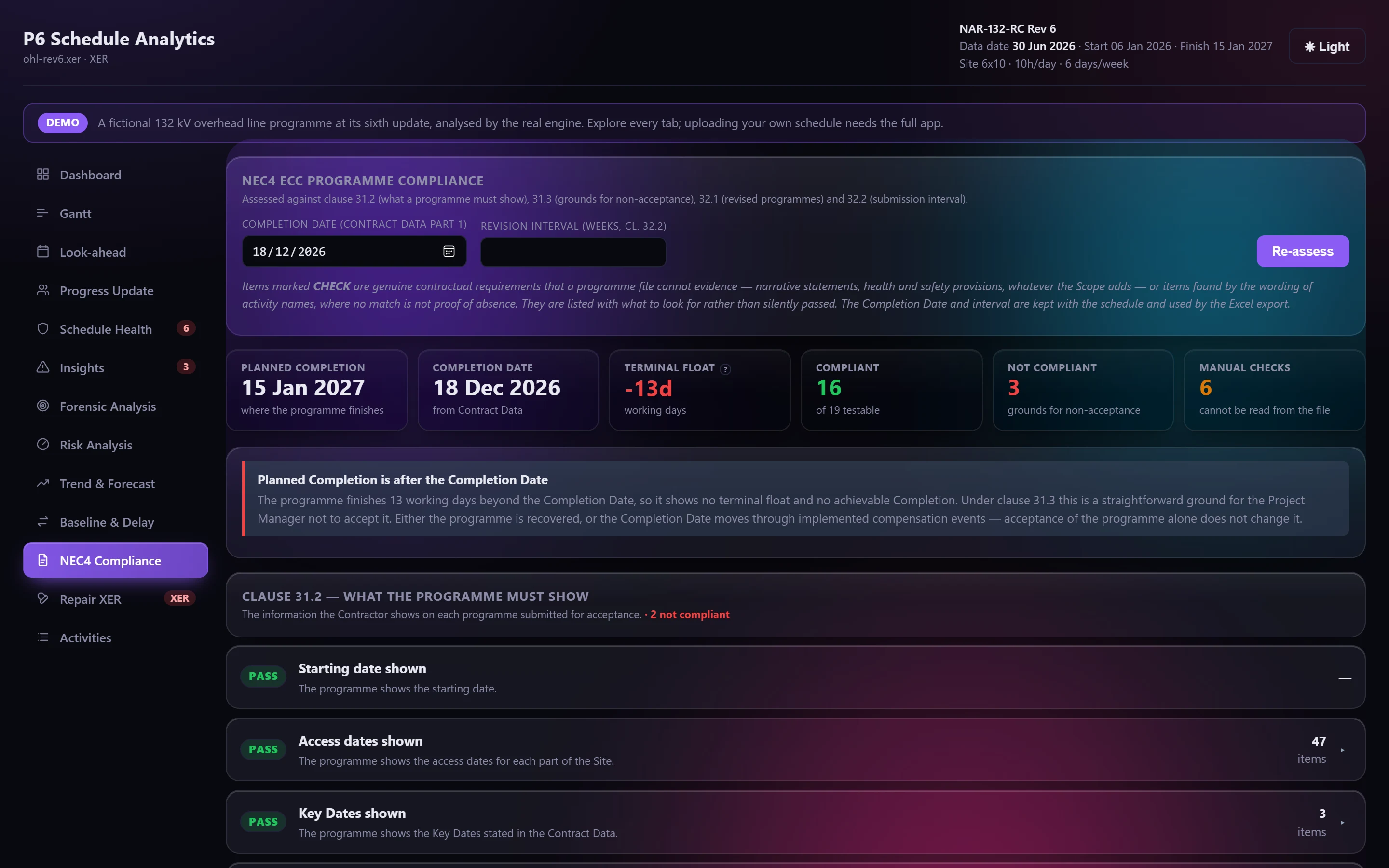
The NEC4 Compliance tab assesses a programme against the NEC4 Engineering and Construction Contract: what clause 31.2 says it must show, the grounds in 31.3 for not accepting it, and the revised-programme requirements of 32.1 and 32.2. It's included in Team and Enterprise plans.
Setting it up#
Enter from Contract Data part one:
- the Completion Date, so planned Completion and terminal float can be measured;
- the Key Dates, so each can be checked for a milestone;
- the revision interval, so clause 32.2 can be checked when you've loaded successive programmes.
These are kept with the schedule, the tab reopens with them, and the Excel export assesses against them.
How items are judged#
Each item passes, fails, doesn't apply, or is marked check by hand with what to look for.
- The programme as it stands now. Work under way counts at its forecast finish, not its frozen planned finish.
- Practicable plans looks at hard constraints on remaining work and at links into open work that progress has broken. Out-of-sequence working that has since finished is as-built history, so it doesn't count.
- Realistic plans checks the file was rescheduled after its last change: stored dates satisfy its own logic and keep unfinished work after the data date.
- Wording. Some items look for activity names that mean what the clause means: an acceptance by someone else, not the Contractor's own review; information received from Others, not the Contractor's own design; a named time risk allowance, not an allowance of time for a task. Where nothing matches, the item is to be checked by hand, not failed, because a name search can't prove absence.
The items#
Clause 31.2: what the programme shows
- The starting date, access dates and Key Dates.
- The Completion Date and planned Completion, and the terminal float between them.
- The order and timing of the operations, and of the work of the Client and Others.
- Provisions for float and for time risk allowances.
- The dates the Contractor needs access to parts of the Site, acceptances, Plant and Materials provided by the Client, and information from Others.
- A statement of how the work is done, from the resources.
- Health and safety requirements and contract procedures, and other information the Scope requires: to check by hand.
Clause 31.3: grounds for non-acceptance
- Plans shown are practicable.
- It shows the information the contract requires.
- It represents the Contractor's plans realistically.
- It complies with the Scope: to check by hand.
Clause 32.1: revised programmes
- Actual progress on each operation, and its effect on the timing of the remaining work.
- The effects of compensation events.
- How delays and notified Defects will be dealt with.
- Other changes proposed to the Accepted Programme: activities added and removed, and re-baselined dates, when a previous programme is loaded.
Clause 32.2: the revision interval
- Revised programmes at no longer interval than the Contract Data states, checked across the data dates of the programmes you've loaded.
On the demo programme#
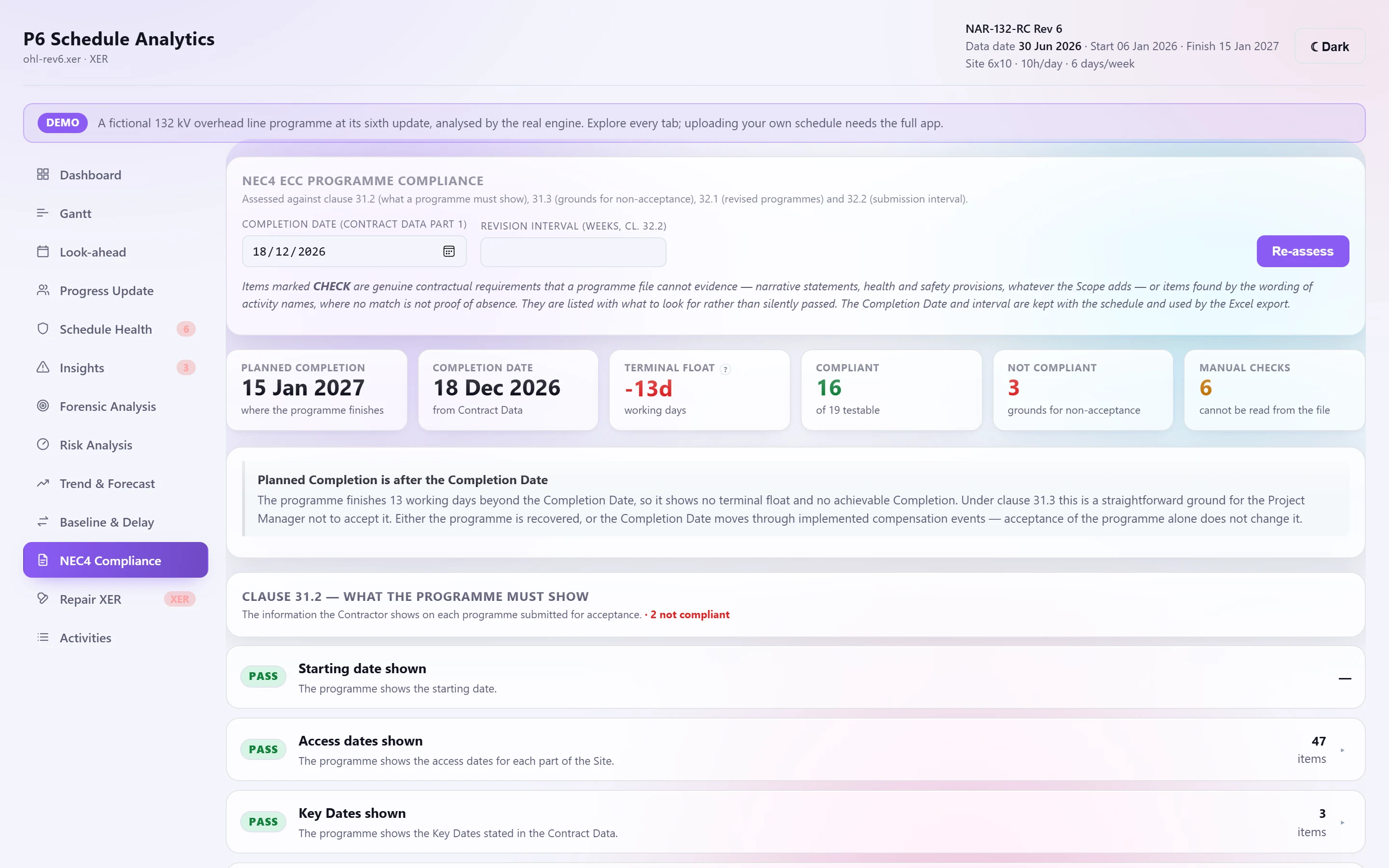
The demo passes 16 items, fails 3 and leaves 6 to check by hand. Its planned Completion is after the Completion Date, which is a clause 31.3 ground on its own: the programme shows no achievable Completion until it's recovered, or the Completion Date moves through implemented compensation events.